Protocol Kardashev
A game about aggressive expansion and climbing the Kardashev scale by building machines with your own intelligence. This page is an early development build: playable, unfinished, and still changing.
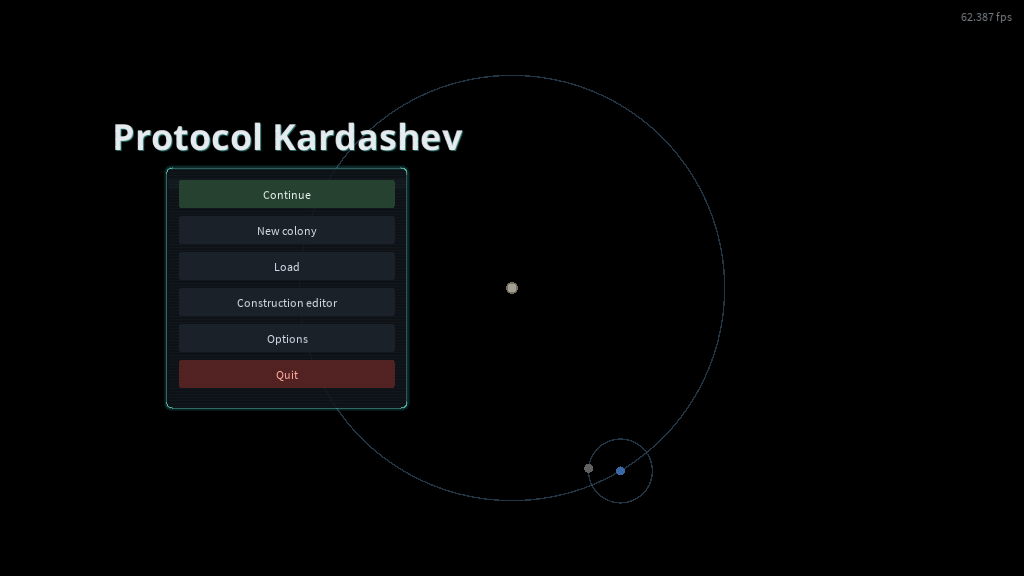
What you do
You land after a failed probe crash with broken systems and a small patch of ground you can see. From there the goal is to expand: take more land, grow your influence, and keep building outward.
Problems keep showing up. Power runs out. Research blocks the next step. Fog covers most of the crust. The game gives you tools, and there is usually more than one way to deal with a problem, so you get to choose how to climb.
Climb the Kardashev ladder
The long goal is civilization scale. Scrap and dirt feed factories. Factories feed ships. Ships lead toward ring slices, orbital rings, interplanetary stations, and star rings that can close into ring worlds. Planets are not just background. Later on they are things you might move.
That ladder is enormous. Early play stays near the crash site on purpose. You dig, claim land, research, and build, but each loop is meant to point at bigger machines and farther reach.
The crash hub
You start small. A crashed lander, a bit of sight, and a Base panel for the systems that survived. Expand from there.
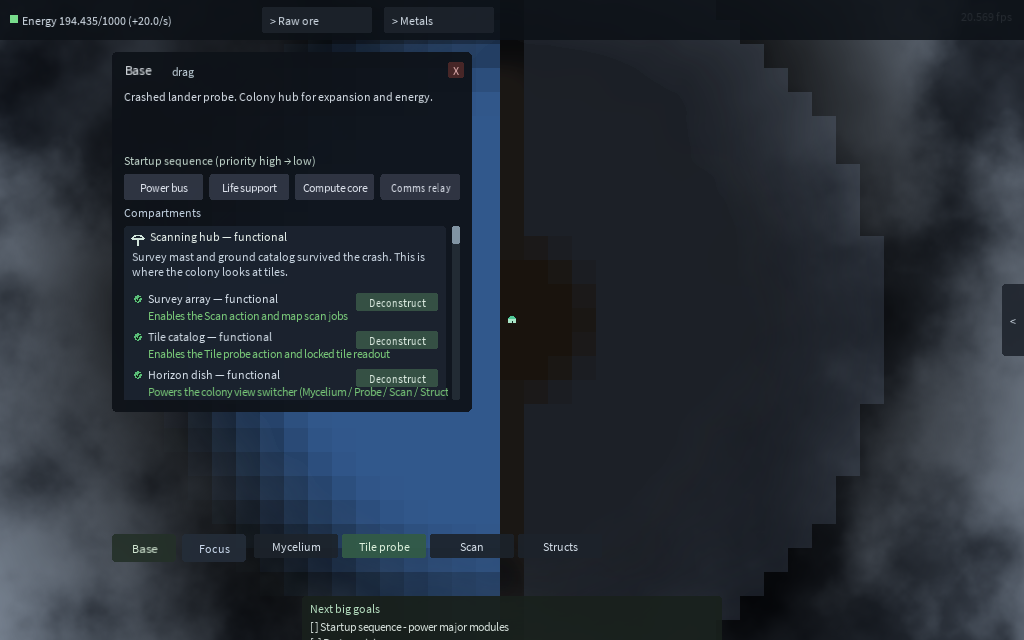
Research unlocks the next tools
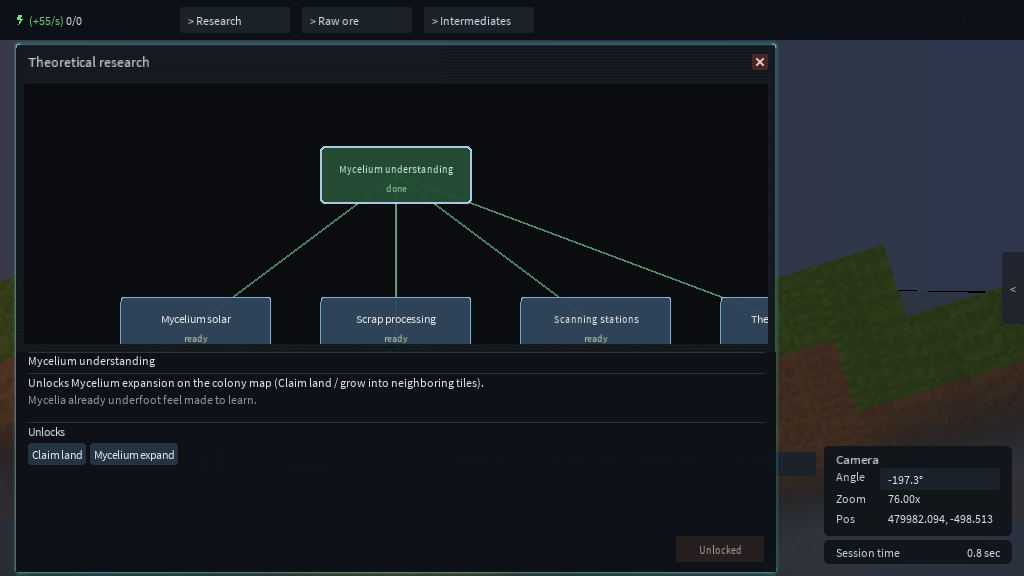
Early tools stay locked until you understand them. Mycelium research opens the growth network. Without the right drones and research, construction stays blocked.
Past that, a physics path sketches ore mining, smelting, and fabrication. Some of that already changes what you can build. Some of it is still coming. Understanding is what opens the next layer.
Watch the pipelines
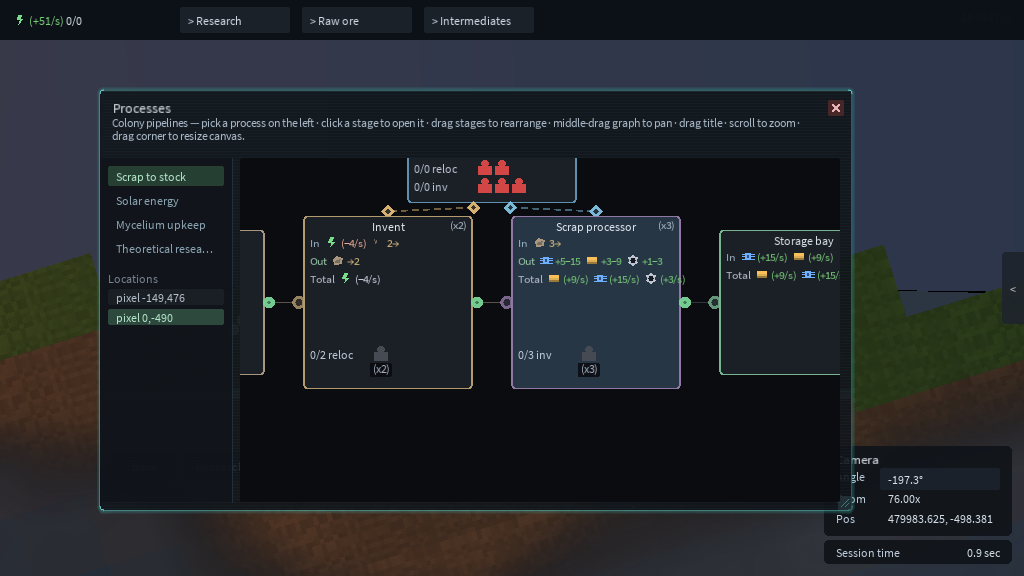
If a building is working, you should see it. Buffers, bots, power, and yields sit on the panel you already opened, so you are not guessing what the colony is doing behind a static card.
Build the machines yourself
Construction is a grid editor for landers and vessels. Blocks connect, rotate, and hold systems. Hull plates are denser than frames. Thrusters add real push. Ghost placement turns green when a piece can attach and red when it cannot.
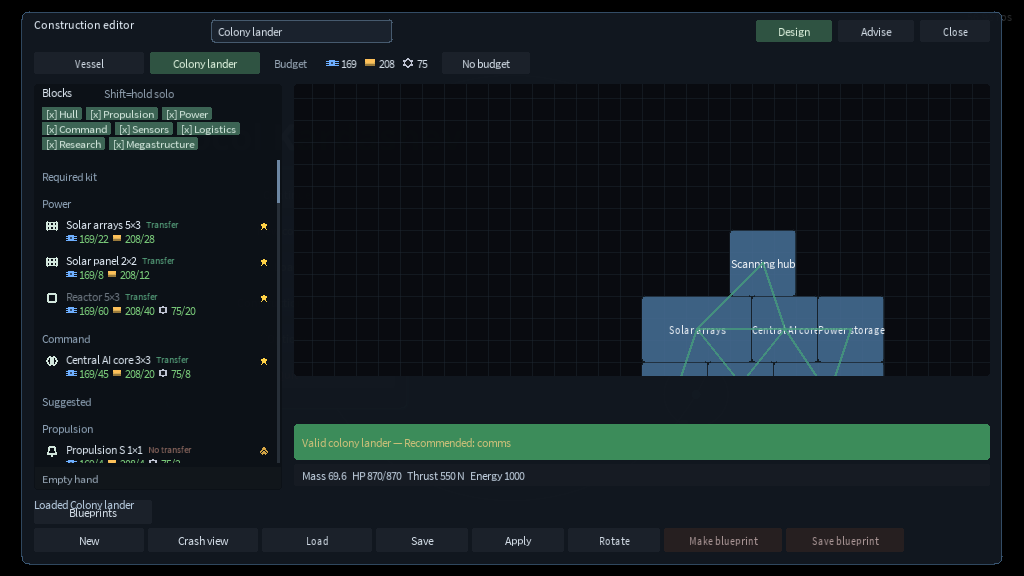
You can save full hull designs or smaller blueprints to reuse later. When a new run starts, the built-in lander is at the top of the picker, with your custom landers underneath if you have any. The idea is to design the next machine yourself, not only pick a preset.
Looking farther out, the same building ideas stretch toward ring slices, orbital rings, interplanetary stations, and star rings. Each step up is huge. The early crash site stays small enough to manage while the long goal stays big.
How it gets made
Most of the game is drafted with AI help. That is not the whole story. Everything still goes through me, Nick, before it counts. Creative direction especially. If the tone, the fantasy, or the next goal feels wrong, I send it back.
So the build moves quickly, but it stays mine. An early development build aimed at aggressive expansion, smarter machines, and a long climb up the Kardashev ladder.